


Project “Małopolska – Inspiration for Your Research Journey”
On 28 January, a ceremonial event was held to inaugurate the project “Małopolska – Inspiration for Your Research Journey”, implemented under the NAWA–EURAXESS Network programme. The meeting brought together representatives of the scientific community, research institutions, and public authorities.
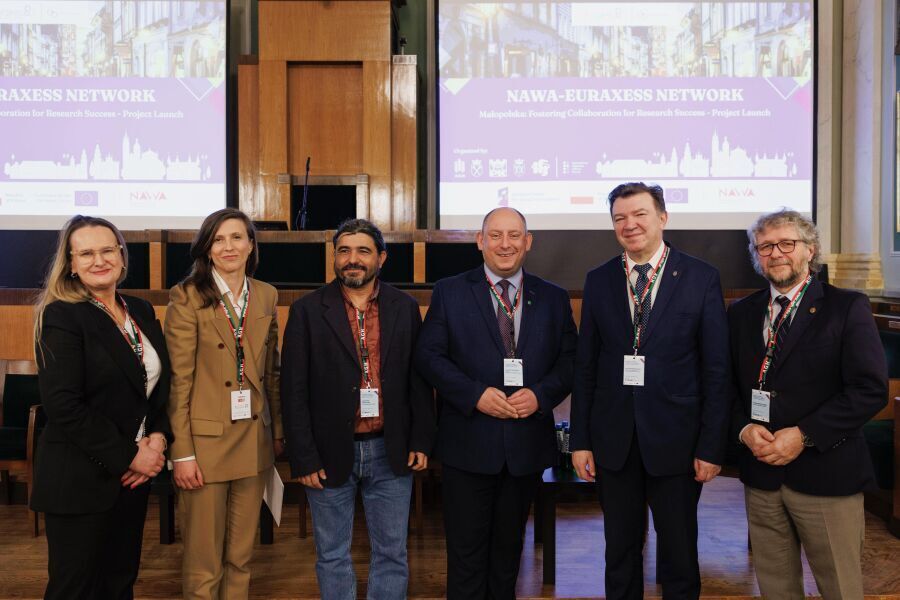
The project is carried out in cooperation with key scientific institutions of the region: AGH University of Science and Technology (the project leader), Jagiellonian University, Cracow University of Technology, Hugo Kołłątaj University of Agriculture in Kraków, and the Institute of Nuclear Physics of the Polish Academy of Sciences.
The aim of the project is to develop a regional support network for foreign researchers coming to Małopolska, create favourable conditions for their professional development, and promote the region as an excellent environment for conducting research and building an academic career.
The event was opened by Prof. Rafał Wiśniowski, Vice‑Rector for Cooperation at AGH University of Science and Technology in Kraków. On behalf of the central and local governments, speeches were delivered by Krzysztof Jan Klęczar, Voivode of Małopolska, and Maria Klaman, Deputy Mayor of Kraków. The National Agency for Academic Exchange (NAWA) was represented by Dr. Piotr Kępski, Director of the Institutional Programmes Department.
During the inauguration, the formal accession of the City of Kraków to the project was emphasised. In her speech, Deputy Mayor Maria Klaman highlighted the long‑term nature of the city’s policy towards foreigners and its importance for the internationalisation of science.
She said:
“Kraków does not implement one‑off projects — Kraków implements a comprehensive policy towards foreigners. The project ‘Małopolska – Inspiration for Your Research Journey’ is a natural extension of actions carried out for years within the Kraków City Strategy and the Open Kraków programme. We want Kraków to be not only an excellent place for conducting research, but also a good place to live for scientists and their families.”
The significance of Kraków joining the project was also underlined by Paweł Świerk, Director of the AGH Centre for International Cooperation, who presented the main assumptions of the initiative “Małopolska – Inspiration for Your Research Journey”. He pointed out the synergy between the activities of universities, local government, and institutions supporting researchers’ mobility.
Participants also learned about the offer and objectives of the NAWA–EURAXESS programme, presented by Monika Zaremba, Coordinator of the EURAXESS Poland Network – NAWA.
An integral part of the inauguration was a discussion panel titled “Research Without Borders – Perspectives of International Researchers in Kraków”, featuring foreign scientists living and working in the city. The panel included:
- Dr Melissa S. Brown (Jagiellonian University),
- Prof. Juan Carlos Loaiza (University of Agriculture in Kraków),
- Dr Rene Poncelet (Institute of Nuclear Physics, PAS),
- Prof. Konstantinos Raftopoulos (Cracow University of Technology),
- Prof. Kun Zheng (AGH University of Science and Technology).
They discussed why they chose Kraków as a place for scientific work and private life, emphasising the high quality of academic cooperation, the friendliness of the environment, availability of services in English, and the cultural attractiveness of the city. One of the key adaptation challenges mentioned was learning Polish — an area supported by the NAWA–EURAXESS programme.
Selected statements:
Prof. Kun Zheng (China):
“I came to Kraków by chance, but stayed by choice. I would not change this decision. In Poland I met the right people at the right time. I can say that I am 100% a product of Polish higher education.”
Dr Melissa S. Brown (UK):
“It started with a grant project involving my husband. He was delighted with Kraków and said we must visit — even for a weekend or a longer holiday. Gradually, that trip turned into a decision to move here and connect our scientific careers with the city.”
Prof. Juan Carlos Loaiza (Colombia):
“Thanks to the support of my Polish colleagues, Kraków feels like my second home, and I see myself as a natural bridge between Poland and Latin America.”
Dr Rene Poncelet (Germany):
“I came to Kraków for a scientific conference and immediately told my wife it was the most European city I had ever visited. After returning as tourists and considering professional opportunities, we concluded it was an excellent place to live.”
Prof. Konstantinos Raftopoulos (Greece):
“On my first visit to Kraków, I walked down Floriańska Street and saw St Mary’s Basilica and the Main Square. I thought it was beautiful and planned to stay here for maybe two years of research. Many years later, I still feel Kraków is my place. Perhaps I miss original Greek food, but otherwise the city offers everything I need.”
Institutional experts also joined the discussion on HR strategies supporting the integration of international researchers, including Dr Ivona Teternel (Croatia), Dr Lluis Rovira Pato (Spain), and Barbara Chiucconi (Italy).
The inauguration of the project marked another important step in strengthening cooperation between local government, universities, and research institutions, and in building the international visibility of Kraków and Małopolska as a region supporting the development of academic careers.