


Tourism Department Activities in 2025
The year 2025 marked another important stage in Kraków’s development of sustainable tourism, combining the city’s high attractiveness with responsible management of tourist traffic. Tourism in 2025 was treated as an integral part of urban policy—connected with residents’ quality of life, cultural heritage protection, climate, mobility, and economic development.
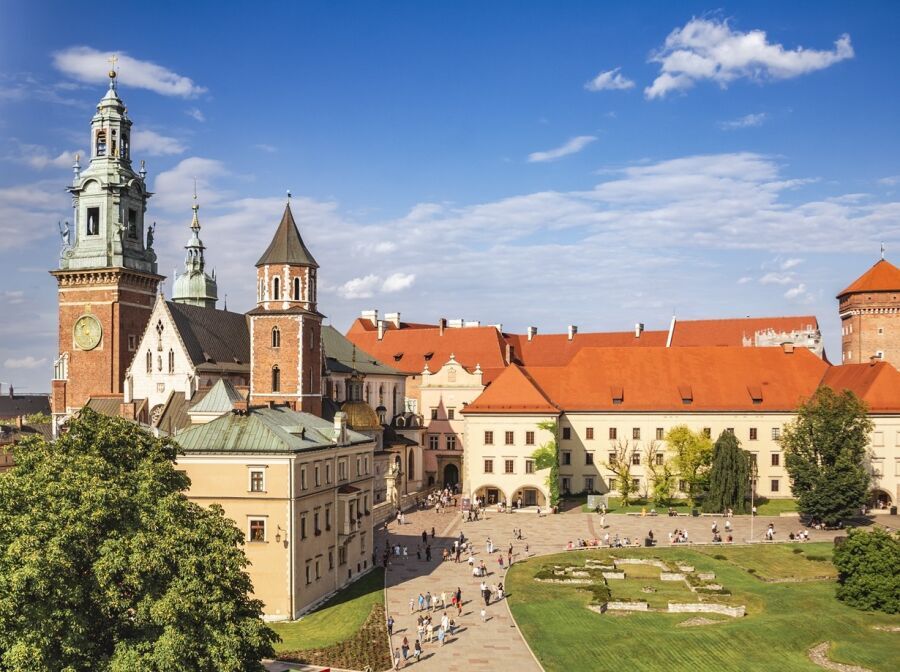
Activities focused on continuing the implementation of a data‑driven approach supported by research and dialogue with stakeholders. Particular attention was paid to sustainable development, dispersing tourist traffic by creating new products, and strengthening responsible behaviour among both visitors and the tourism industry. Kraków also actively participated in international knowledge exchange, using its position as a historic city to initiate and co‑create the debate on the future of urban tourism in Europe.
Tourist Traffic and Its Structure
In 2025 Kraków maintained a high dynamic of tourist arrivals. During the peak season, the city welcomed around 3 million domestic visitors and nearly 700,000 international guests. Mobile data analysis confirmed a stable increase in interest in Kraków. An increasingly clear trend was the more even distribution of visits throughout the year—one of the goals of sustainable tourism management.
Among international visitors, the largest groups came from Germany, the United Kingdom, and the United States. At the same time, there was a noticeable increase in arrivals from the Czech Republic, Slovakia, Israel, and Gulf countries, including the United Arab Emirates.
Research and Data‑Driven Management
The year 2025 saw further development of systematic research on tourist traffic and analyses of its impact on city operations. Kraków used traditional surveys and gathered data from mobile applications and payment cards—these will be used to prepare detailed insights into tourism for 2025.
An important component of the research was the analysis of residents’ attitudes towards tourism, launched in December 2025, partly based on Doxey’s Irritation Index. Studies on Kraków’s night‑time economy were also conducted, serving as a foundation for deeper analyses of this aspect of urban life.
In cooperation with the Małopolska Tourist Organization, research was carried out to determine the economic significance of tourism and the meetings industry for Kraków’s economy. The findings will be published in 2026 and will support strategic decision‑making in the tourism sector.
Sustainability and the GDS Index
One of the key achievements of 2025 was Kraków’s significant improvement in the Global Destination Sustainability Index (GDS Index). This international ranking compares cities based on approximately 70 indicators covering environmental actions, social issues, engagement of local suppliers, and destination management.
Kraków scored 62.2%, improving by 12.9 percentage points, and advanced from 72nd to 53rd place among 81 destinations worldwide. The city ranked 2nd in the “Most Improved Destinations” category, confirming the effectiveness of its long‑term sustainability strategy.
The ranking highlighted both strong areas and those needing further work. The greatest progress was recorded in cooperation with the local tourism industry, social initiatives, and environmental actions. The number of certified accommodation facilities increased, urban space accessibility improved, and issues such as responsible short‑term rental management and climate protection were more strongly integrated into strategic city documents.
Respect Kraków – Responsible Tourism in Practice
Kraków has been running the Respect Kraków program for several years, encouraging visitors to explore the city while respecting the needs of residents. In 2025 the program was expanded with a new formula. Its online campaign in Polish and English reached domestic and international visitors as well as residents.
A large‑scale outdoor campaign ran in parallel. In addition to standard channels such as Bus TV, Kraków City Card machines, and citylights, ads appeared on buses, tram seat backs, and at the Main Railway Station. Campaign messages were also displayed in the airport baggage claim area, and leaflets were distributed at MPK stops. Key materials were placed in short‑term rental accommodations, and local businesses and residents helped spread them.
Program ambassadors, the City Helpers, patrolled the Old Town, Kazimierz, and the Vistula Boulevards from mid‑June to mid‑September. They worked daily from 18:00 to 1:00, and on weekends until 2:00. They assisted visitors, responded to inappropriate behaviour, measured noise levels, and conducted observations among tourists and residents—collecting valuable data for shaping Kraków’s night‑time policies.
For over a year, Kraków has also had a Night Mayor, responsible for balancing the interests of residents, businesses, and tourists. During the 2025 season, he joined City Helpers on night patrols, observing the situation firsthand and engaging with stakeholders. Together with the Night‑Time Economy Commission, he worked on issues related to night‑time tourism, safety, entrepreneurship, culture, and transport. His efforts included promoting good practices for hospitality venues, negotiating with the entertainment sector, and developing rules for pub crawls to minimize residents’ discomfort.
Historic Cities 3.0 – International Cooperation
In April 2025 Kraków hosted the 4th edition of the Historic Cities 3.0 conference, devoted to the sustainable transformation of historic cities. The event brought together experts, scientists, and representatives of European cities to discuss how to balance the protection of cultural heritage with tourist accessibility, innovation, and community needs.
The conference focused on tourism as a tool supporting sustainable development. Its conclusions will inform Kraków’s future urban policies in tourism, resident participation, green space management, and the night‑time economy.
In October, the first webinar of the Historic Cities 3.0 project took place: “New cultural tourism spaces in historical cities: where sustainability meets creativity”, organized as part of the SCT HUB initiative. Representatives of Kraków, Poznań, Alba Iulia, and Venice discussed innovative and sustainable approaches to cultural tourism.
EU Projects and Innovative Approaches
The year 2025 was also a period of intensive implementation of projects financed by the European Union. The most important of them was SCT HUB (Codesign the Future of Sustainable Cultural Tourism), as part of which the Sustainable Cultural Tourism Hub will be established in the Wesoła district. Innovations developed within this broad partnership will allow the use of AI tools to create and prototype solutions to challenges related to tourism in historic cities. Kraków is treated in this project as a “living lab”, enabling bold solutions to be tested directly within the urban fabric.
The project has a budget of nearly €5 million, with the city receiving funding through the European Urban Initiative. It is being implemented in close partnership with the Kraków Festival Office, Krakow Tourism Alliance, Jagiellonian University, the Kraków Development Agency, and the Polish Heritage Foundation, with the City of Kraków acting as the project leader. The project also includes transfer cities: Braga, Venice, and Alba Iulia.
In parallel, within the Tourism in Balance project (Interreg Europe), worth nearly €0.9 million, Kraków exchanged experiences with major cities such as Rome, Amsterdam, and Tallinn. The cooperation aims at developing strategies that minimise the negative effects of overtourism while maximising benefits for local communities.
Kraków During Poland’s Presidency of the EU Council
In 2025 Kraków played an active role in Poland’s Presidency of the Council of the European Union. The city hosted and co-organised numerous international events, including conferences and forums focused on urban development, innovation, and sustainable tourism. One of the key events was the 6th Cities Forum, which strengthened Kraków’s position as a city engaged in European dialogue.
In June, an outdoor final concert of the Presidency’s cultural programme took place, symbolically linking local heritage with the European artistic community. The city also used this time to present investments and build cooperation with EU institutions, acting as an active host for events of European significance.
Business Tourism and the MICE Sector
In 2025 Kraków continued to strengthen its position as an attractive destination for business tourism. The city hosted 4,647 group business meetings, an increase of 6.4% compared to the previous year.
The report “Meeting Industry in Kraków 2024” (prepared in 2025) indicates a real boom in corporate and incentive events—their number almost tripled, accounting for more than half of all business meetings held in the city.
Market recovery was clearly visible:
- the total number of event participants grew by over 35%, mainly due to the return of major international events,
- hotels became the main hosts of meetings, accommodating 70% of all registered events,
- Kraków maintained a strong position in global rankings: 26th in Europe (ICCA) and 31st worldwide (UIA),
- the Kraków Convention Bureau supported 65 events.
Growing numbers of inquiries and study visits further confirmed the city’s attractiveness for conferences, congresses, and international meetings.
In 2025, the Kraków Network project was formally integrated into the Department of Tourism as Kraków Network 2.0, enabling even closer cooperation within the MICE community. Members met twice that year, discussing topics such as Kraków’s premium offer. A new meeting series, “Otwarta Bracka”, was launched to create a regular dialogue platform for local government, entrepreneurs, and residents.
- Development of the City’s Offer and Promotion
- Kraków continued to expand its tourism offer in 2025.
- The Dragon Trail gained additional dragon figurines.
- The Kraków Women’s Trail – Krakowianki continued to grow.
- Nowa Huta joined the ATRIUM European Cultural Route.
- New and updated information materials were produced in 19 language versions, in both print and digital formats.
A new guide, “Kraków After Dark”, was created, highlighting nighttime attractions, venues, culinary offerings, public transport guidance, and safety tips.
The city intensified its support for NGOs. Three open calls for proposals were held, focusing on:
Kraków Fortress Days
A new network of informational and educational points
Broader support for tourism projects, resulting in new city quests and the Kraków Culinary Trail
In 2026 the funding pool for NGOs will increase to PLN 1 million.
Promotion and International Presence
In 2025 Kraków was present at 18 trade fairs across three continents, including:
- FITUR (Madrid)
- ITB (Berlin)
- WTM (London)
- ATM (Dubai)
- IMEX (Frankfurt and Las Vegas)
- IBTM (Barcelona)
- as well as national events such as Tour Salon (Poznań) and ITTF (Warsaw).
Altogether:
- over 60 days of promotion,
- hundreds of B2B meetings,
- distribution of approx. 10,000 promotional materials,
- fairs visited by over 1 million people.
Kraków also organised 60 study visits for journalists and influencers from 17 countries, including the USA, Japan, Saudi Arabia, Colombia, and Australia. Coverage appeared in renowned outlets such as Trip Reporter, Jerusalem Post, Berliner Umschau, and National Geographic.
The city maintained a strong media presence with publications in titles such as National Geographic, Travel Polska, Wiadomości Turystyczne, and LOT’s inflight magazine Kaleidoscope.
A notable long-running initiative was the “Friend of Kraków Badge” programme, carried out with the Polish Sightseeing Society (PTTK), which continued for its 50+ year with strong participation—over 4,000 participants in spring and autumn editions.
The city also co-organised events promoting local culture and products, such as the Kraków Honey Harvest, Kraków Mountain Festival, International Tourist Guide Day, and the 3rd Bagel Day (Dzień Obwarzanka). The Kraków Fortress Days were especially popular, attracting several thousand participants.
Communication with the tourism industry and residents also took place digitally through websites (turystykakrakow.pl, convention.krakow.pl), social media (Facebook, LinkedIn, YouTube), newsletters, and monthly event calendars.
Registry of Accommodation Facilities
In 2025 the Department of Tourism continued its registry and inspections of accommodation providers not classified as hotels, including short‑term rentals and campsites, in accordance with Polish hospitality regulations. Activities included:
- identifying accommodation providers,
- conducting explanatory proceedings for non‑registered entities,
- updating entries,
- ongoing support for entrepreneurs,
- inspections.
As of 31 December 2025, the registry included:
- 2,576 active facilities,
- 36,507 accommodation places,
- plus approx. 2,000 seasonal places.
The city also conducted extensive promotional and informational activities regarding registration requirements for short‑term rentals.
In June, Kraków hosted an international seminar “Short‑Term Rental in Tourist Cities – Balancing Tourism and Local Communities”, the first such debate focused on analysing the intensification of short‑term rentals and their impact on tourist cities.
Tourist Tax and Guiding Services
Kraków has long advocated for the introduction of a tourist tax in Poland as a tool supporting sustainable tourism management. The city proposed a draft law as early as 2017, enabling municipalities to introduce such a tax.
The funds would be allocated entirely to municipalities and used to cover costs of intensive tourist traffic—public space maintenance, safety, heritage protection, and mitigation of nuisances for residents.
In 2025 organisational changes in the Ministry of Sport and Tourism resulted in the announcement of legislative work enabling local governments to collect a tourist tax, with Kraków actively participating in consultations.
The Department of Tourism has also been cooperating with Kraków’s tourist guides to improve service quality and protect cultural heritage. In June 2025 the Mayor submitted a legislative proposal allowing local standards for guiding services in areas of exceptional historical and cultural value.
Tourism Forum – New Directions for Kraków
In December, Kraków hosted the Tourism Forum, a cyclical event bringing together experts, industry practitioners, cultural and creative sector representatives, municipal units, and residents. The event provided space for discussions on quality, authenticity, and sustainable tourism—balancing tourist needs with residents’ comfort.
Participants reviewed tourism data, discussed municipal projects (night‑time economy, product development, promotional campaigns, international projects), and explored themes such as culinary tourism, city authenticity, and positioning Kraków as a premium destination.
Summary
The year 2025 was a period of intense work to ensure that tourism in Kraków develops sustainably and remains friendly to both visitors and residents. The city consistently focuses on knowledge, dialogue, and practical solutions—from tourism research and international cooperation to local initiatives in public space.
Programmes such as Respect Kraków, night‑time economy development, and international projects show that responsible tourism is both possible and necessary. Kraków continues to strengthen its position globally as an attractive, open, and forward‑thinking city, aware of the challenges posed by intensive tourism and committed to maintaining a balance between hospitality and high quality of urban life.