


Summary of the Tourism Forum 2026
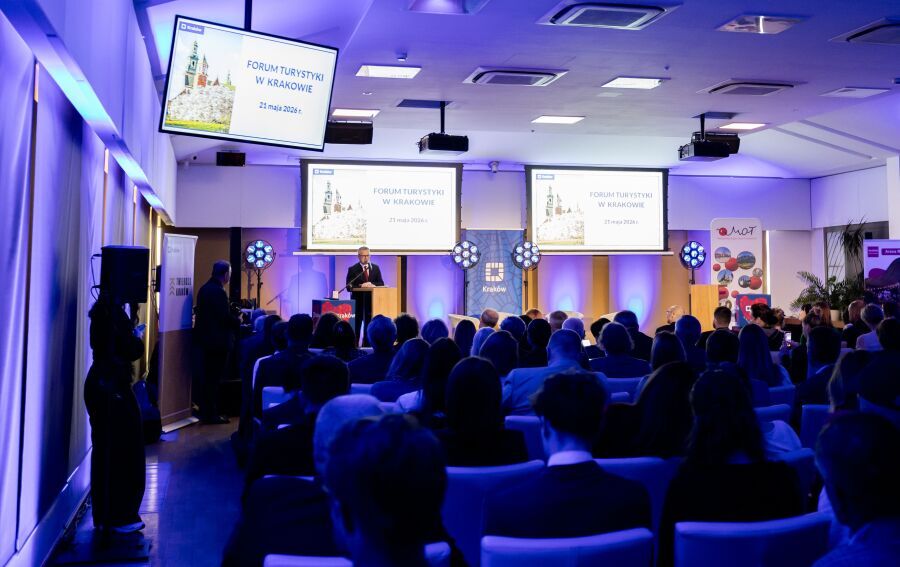
On May 21, 2026, the Tourism Forum took place at the Krzysztofory Palace on Kraków’s Main Market Square. The event was dedicated to the future of tourism in Kraków, the city’s sustainable development, and cooperation among stakeholders from tourism, culture, sports, and business. During the Forum, the current tourism offer of Kraków was presented, along with key development directions and new projects strengthening the attractiveness and competitiveness of the capital of Małopolska. Participants included representatives of local government, municipal institutions, tourism organizations, academia, and the meetings and events industry.
“Honoris Gratia” distinction for Targi w Krakowie
The Forum was officially opened by Stanisław Mazur, Deputy Mayor of Kraków, who presented the “Honoris Gratia” badge to President Ewa Woch and Vice President Paweł Nikliński, representing Targi w Krakowie Sp. z o.o.
The distinction was awarded in recognition of the company’s long-standing contribution to Kraków’s economic, trade fair, and congress development, as well as to the promotion of the city in Poland and abroad. It highlights the role of Targi w Krakowie as the largest trade fair and congress organizer in southern Poland and the third largest in the country. For 30 years, the company has organized international industry events, continuously developing and modernizing the trade fair formula in response to market needs and shaping new trends in the meetings and business events sector.
Kraków’s development strategy and tourism
In his speech, Stanisław Mazur presented the assumptions of the document “Kraków Development Strategy. This is where I want to live. Kraków 2030.2050,” describing it as a new-generation strategy defining long-term development directions and preparing the city for future social, economic, and climate challenges.
The presentation covered, among other things, the role of tourism-related issues within the strategy, as well as the importance of business, congress, and festival tourism, and support for the MICE sector and conference-exhibition infrastructure in a sustainable development framework. Mazur also spoke about building a strong brand for Kraków as an open, creative, green, and digital city, based on culture, innovation, and a high quality of life.
He emphasized the importance of partnership and co-governance involving the city, tourism sector, cultural institutions, universities, NGOs, residents, and metropolitan municipalities. He also highlighted data-driven management, trend monitoring, and analyzing tourism’s impact on the city.
“Tourism is not a separate area—it is a point of intersection of key city policies. Sustainable tourism should deliver value to residents, the economy, and the entire metropolitan area,” he noted.
Tourism in Kraków: between success and responsibility
Natalia Kulec-Greń, Director of the Tourism Department, presented “Tourism in Kraków 2026 – between success and responsibility,” emphasizing that modern tourism policy is a core element of city management.
“Tourism is not just marketing and promotion—it is city management,” she stressed.
She discussed balancing the interests of tourists, residents, and the local economy, as well as managing visitor flows responsibly to ensure destination quality, dispersing tourism, and promoting responsible behaviors. She highlighted Kraków’s intention to learn from other European cities and avoid mistakes related to overtourism, citing Barcelona as an example.
Key challenges mentioned included short-term rentals, the need for tools such as a tourist tax, managing resident–visitor conflicts, complaints, and mediation processes. She also emphasized corporate social responsibility in tourism, environmental awareness, and the importance of maintaining tourism as a positive element of quality of life. Safety was identified as a fundamental pillar of tourism development.
She also addressed product development, support for business events, international cooperation, study visits, and data-driven management. She pointed out that geopolitical conditions and changing travel trends influence the tourism market, and highlighted the growing role of technology and AI in communication and city branding.
Analysis of early 2026 data showed a gradual leveling of tourism flows across months, indicating more balanced distribution over time. Although January and April saw declines, overall growth was driven by increases in traditionally weaker months. The structure of visitors is also changing, with a growing share of international tourists strengthening the premium segment.
She concluded:
“The tourism of the future is a choice, not a coincidence—Kraków is not abandoning tourism, but managing it in a mature way.”
Record tourism data
Dr. Krzysztof Borkowski presented the latest tourism data for 2025, prepared in cooperation with the Małopolska Tourism Organization and an inter-university expert team.
Most visitors—including day-trippers—were domestic, mainly from the Małopolskie, Śląskie, and Mazowieckie regions. Among international visitors, the top countries were the United Kingdom, Germany, and Spain, with growing importance of southern European markets such as Spain and Italy.
Leisure remained the primary purpose of visits, but green spaces are becoming increasingly important attractions. There is also a growing share of guests staying in 4- and 5-star hotels, confirming the rising importance of the premium segment.
Visitor spending reached PLN 15.4 billion in 2025, an increase of over 70% year-on-year. Total visitation exceeded 16 million people, representing a 10.4% increase compared to the previous year.
Cooperation and tourism product development
Grzegorz Soszyński, President of Kraków Tourism Alliance, highlighted the importance of cooperation with businesses and cultural institutions in commercializing tourism products.
He presented plans for an integrated tourist information system, development of information points, and a tourist card project. He emphasized dialogue with residents and strengthening shared responsibility for Kraków’s heritage.
A record year for Kraków Airport
Łukasz Strutyński, President of Kraków Airport, outlined development plans, including new air connections, a supporting terminal, expansion of the passenger terminal, modernization of the Aviation Education Centre, and a new runway.
In 2025, the airport handled over 13 million passengers, becoming Europe’s fastest-growing airport in the 10–25 million passenger category. Despite geopolitical tensions, he noted no risk of aviation fuel shortages.
Culture, events, and collaboration
Paweł Szczepanik, the Mayor’s Plenipotentiary for Culture, presented Kraków as a city of heritage, culture, innovation, and creativity.
He discussed the Cultural Development Program and Pact for Culture, focusing on strengthening the cultural ecosystem, improving service standards, and fostering cooperation. He highlighted partnerships among cultural institutions and key events such as Kraków Nights, the Great Dragon Parade, SummerJazz Festival Kraków, and Wianki.
He also emphasized infrastructure projects like the Wesoła revitalization and the planned Music Centre.
Sport as a promotional tool
Katarzyna Stępniewska-Walaszczyk highlighted sport’s role in tourism and city promotion:
“Sport is a year-round tourism tool for Kraków—not just seasonal.”
She presented data on the economic impact of sports events and upcoming plans, including the 2027 FIVB Volleyball Men’s World Championship.
Discussion on the future of events
A panel discussion moderated by Michał Zalewski featured leaders of major event venues in Kraków. Topics included attracting large events, coordination, ESG standards, carbon footprint reduction, cost optimization, and communication with residents.
Cybersecurity, adapting venues to artists’ requirements, and balancing business needs with residents’ interests were also discussed. The panel emphasized cooperation and the importance of events in building Kraków’s brand.
Craftsmanship and culinary heritage
Dr. Joanna Dziadowiec-Greganić presented the new “MASTERS – Kraków Craft Trail,” promoting traditional crafts, local brands, and collaboration between institutions and artisans.
She highlighted the importance of craftsmanship in shaping Kraków’s identity and referenced related initiatives like fairs and exhibitions.
Dr. Marcin Gadocha introduced the Historic Kraków Culinary Trail, linking heritage locations with culinary traditions and showcasing both well-known and disappearing recipes, emphasizing the role of culinary heritage in tourism.
Summary
The Tourism Forum 2026 covered a wide range of topics—from development strategy and tourism management to cultural, sports, infrastructure, and new tourism offerings. It demonstrated Kraków’s commitment to a tourism model based on quality, responsibility, and cooperation.
The Forum highlighted that the future of tourism lies not only in growth but in conscious management of its impact on the city and residents. With a strong focus on sustainability, heritage preservation, and authentic experiences, Kraków continues to strengthen its position as a modern and responsible destination ready for future challenges.