


City guides – ambassadors of Kraków
For many people, the profession of a city guide is still associated with the need to hold a state-issued licence. In reality, however, the legal framework has been very different for more than a decade. The key piece of legislation governing the profession remains the Act on Hotel Services and the Services of Tour Leaders and Tourist Guides, which defines the fundamental responsibilities of a guide: leading visitors, providing reliable information about the places they visit, and ensuring the care and safety of the group.
Everything changed in 2013 with the entry into force of the so-called Deregulation Act. From that moment, the profession of a city guide was fully deregulated, and the state ceased to control access to the profession as it had previously done. There are no longer any state examinations, regional licensing commissions, mandatory identification badges or official guide licences. Anyone who is at least 18 years of age, has completed secondary education and has no criminal record for offences related to the profession may work as a city guide.
Although more than a decade has passed since deregulation, the issue continues to generate considerable debate. For some, it represents greater economic freedom and an opportunity to develop their own tourism businesses. For others, it raises concerns about the quality of guiding services and the safety of visitors.
In Kraków, the discussion remains particularly active. For many years, local guides have called for legislative changes that would restore the profession's recognised status. Emphasising the exceptional value of Kraków's cultural heritage, the Mayor of the City of Kraków and the municipal authorities have repeatedly appealed to successive ministries responsible for tourism to introduce regulations for areas of outstanding cultural significance, such as Kraków's Cultural Parks. The proposed solutions were intended to establish quality standards that would genuinely improve guiding services within the city's historic areas, which require a particularly high level of protection.
Managing a site inscribed on the UNESCO World Heritage List places special responsibilities on the city. Kraków has consistently emphasised that, without coherent and effective national legislation, it is difficult to monitor guiding services adequately and maintain consistently high standards.
The City of Kraków works closely with tourist guides throughout the year, and this cooperation extends beyond practical initiatives to include symbolic recognition of their profession. For more than twenty years, the Kraków City Office, together with guide associations and invited partners, has celebrated the International Tourist Guide Day, observed annually on 21 February. The occasion highlights the important role that city guides play in shaping the image of the destination while also encouraging Kraków residents to discover their city's history through free guided walks.
Another annual celebration is World Tourism Day, observed on 27 September. Together with the Federation of Tourist Guide Associations, the Kraków City Office organises a special ceremony during which graduates of guide training programmes receive their official guide badges, known locally as blachy przewodnickie. This is an important milestone for the guiding community, officially welcoming newly qualified guides into the profession. In keeping with tradition, the new guides subsequently invite Kraków residents to join complimentary guided tours, details of which are published on the official city website.
The Federation of Tourist Guide Associations (FSP) was established in 2014 at the initiative of the Kraków City Office in response to the deregulation of the profession. From the outset, its mission has been to support guides in developing their professional qualifications, expanding their knowledge and creating new visitor routes in order to maintain a high standard of guiding services. With this objective in mind, the Tourism Department of the Kraków City Office also supports city guides by organising training sessions dedicated to new tourism products, including the Kraków Women's Heritage Trail – Krakowianki and the Kraków Fortress heritage route.
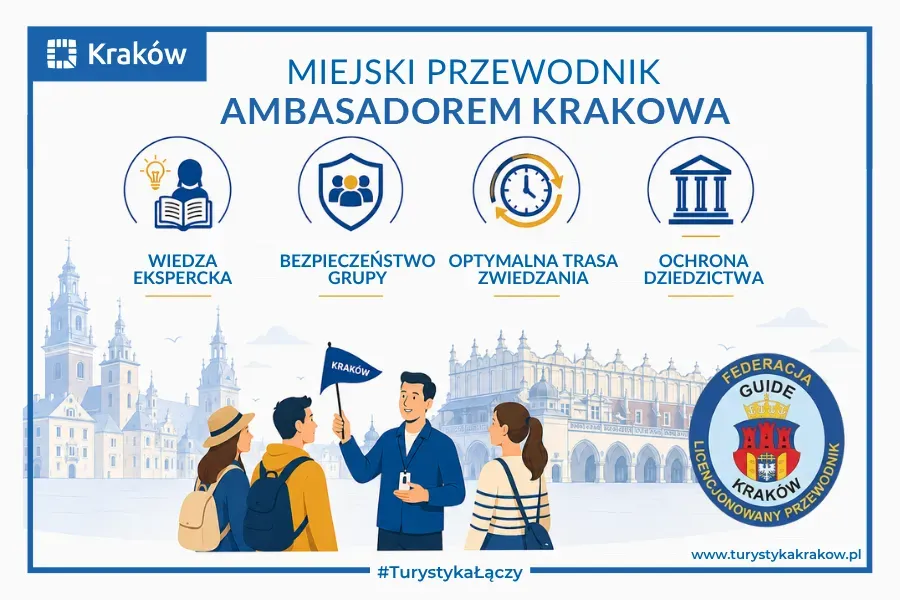
The support provided by the City of Kraków to the Federation also has a unique symbolic dimension. Recognising the exceptional role guides play in promoting the city's image, the Kraków City Council approved the Federation's proposal that only licensed guides affiliated with the Federation may use the Coat of Arms of the Royal Capital City of Kraków, a legally protected municipal symbol. Permission to use the coat of arms is granted exclusively by the city authorities and is subject to strict regulations. It appears on both the official guide badge and the personalised guide identification card, two elements that distinguish licensed city guides. This privilege is regulated by Resolution No. CXIII/1761/14 of the Kraków City Council, adopted in 2014.
Today, the Federation brings together six city guide associations, representing a total of 655 licensed guides who conduct tours of Kraków in more than a dozen languages.
The official guide badge is a symbol of the dedication and extensive knowledge required to become a professional city guide. By choosing a guide who has completed accredited training and holds the official guide badge, visitors can be confident that they are discovering Kraków through reliable, high-quality interpretation provided by experienced professionals.
This article is part of the City of Kraków's publication series on the state of tourism in Kraków. The series aims to explain key concepts and trends shaping the city's tourism sector, analyse its strengths and challenges using evidence-based data, and encourage active dialogue between residents, businesses and local government.