


MINEV project – study visit to Belgium
On December 11–12, 2025, representatives of selected cities and regions from Europe, including Kraków, participated in a series of meetings as part of the MINEV (Material Resources Management and Circular Economy) project, co-financed by the Interreg Europe program. The purpose of the study visits to Bruges, Mechelen, and Brussels was to learn about best practices in waste management, the organization of sustainable events, and public procurement supporting the circular economy.
MINEV – a shared vision for cities
The MINEV project was created to help cities transition to a circular economy through better management of material resources. It aims to reduce waste at source, develop innovative recycling methods, and facilitate knowledge exchange between local governments. The project involves regions from Spain, Greece, Lithuania, Italy, and Poland, among others, and is coordinated by ACR+, an organization that has been supporting cities in their ecological transformation for over 30 years.
Bruges – an ambitious program and practical solutions
The first day of the visit took place in Bruges, where the Political Program 2025–2030 was presented. The city is focusing on clean neighborhoods, the development of urban greenery, and a comprehensive plan to combat littering. The program includes preventive and educational measures as well as strengthened enforcement of regulations. Particular attention was paid to the policy on events – organizers are required to prevent waste generation and clean up the area after events.
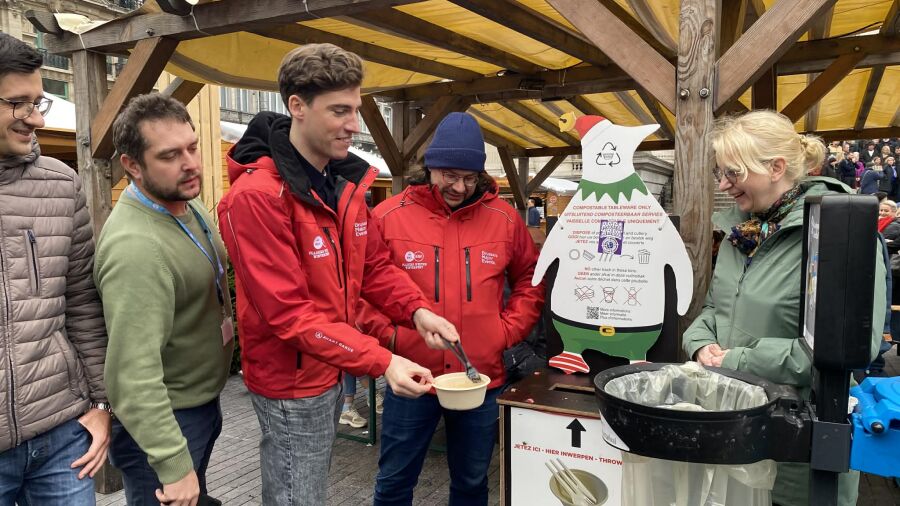
The delegation had the opportunity to see how these rules work in practice during a visit to the Bruges Christmas Market. The city has implemented waste sorting islands, special containers for cigarette butts, and a system of reusable cups with QR codes. Underground waste containers were also presented, which have been tested in the center of Bruges since 2025, improving the aesthetics of the city and reducing the problem of overflowing bins during periods of increased tourist traffic.
Brussels – how to organize sustainable events?
On the second day, participants visited Brussels, where they learned about the activities of the Brussels Climate Plan. The city organizes more than 3,000 events a year, including the famous Winter Wonders (Plaisirs d'Hiver) – a 45-day fair visited by four million people. Brussels has been implementing a reusable cup system for years, which reduces waste by hundreds of tons. There are 240,000 cups in circulation, each used on average three times during a single edition. The city is also testing reusable tableware for catering – in 2023, more than 66,000 pieces were used, saving over a ton of waste. There are plans to standardize sugarcane packaging and automate return systems.
OVAM – Flanders in the fight against waste at events
During a session with OVAM (Public Waste Agency of Flanders), regulations and good practices for reducing waste at mass events were discussed. Since 2020, reusable cups have been mandatory at events organized by local authorities, and from 2030, the ban on single-use packaging will apply to all events. The results are impressive: the Lokerse Feesten festival reduced waste by 60% compared to 2019, and Sfinks Mundial reduced waste per participant by 56%, achieving a 96% return rate for cups and dishes. OVAM supports organizers through advice, information campaigns, online tools, and funding.
ACR+ – the power of public procurement in the circular economy
During the MINEV project meetings, particular attention was paid to the role of public procurement in the transition of cities towards a circular economy. It is the public sector, which accounts for a significant part of spending in Europe, that can become a driver of change by introducing circular criteria in tenders.
ACR+, an organization that has been supporting cities and regions in this transition for over 30 years, presented its activities in this area. A key tool is the C-PRONE platform, described as a “one-stop-shop” for circular public procurement. It gives institutions access to knowledge, tools, training, and good practices that facilitate the implementation of circular economy principles in everyday purchasing procedures.
- ACR+ also implements a number of European projects that support organizations in changing their approach to procurement:
- Circular Minds – focuses on changing mindsets and building competencies in circular procurement.
- Circular Shift – accelerates the implementation of circularity principles in the procurement of IT equipment and workwear.
- CE-PRINCE – supports green procurement in Central Europe by creating standards and business models.
- CISUTAC – develops guidelines for public procurement in the textile sector to reduce the environmental impact of the clothing industry.
Examples of implementations show that this approach brings real benefits. The Dutch municipality of Losser used innovative procurement for road maintenance, which reduced CO₂ emissions by 38% and generated environmental savings of thousands of euros. Meanwhile, the UZ Gent hospital in Belgium introduced eco-friendly uniforms for more than 4,000 employees, reducing water consumption by 95% and CO₂ emissions by more than 30%.
ACR+ emphasizes that public procurement is not only a purchasing tool, but also a powerful lever for change—it influences the market, stimulates innovation, and supports local economies. Combined with the actions of cities such as Bruges and Brussels, it creates the foundation for a truly circular Europe.
Why is this important?
Public procurement and event regulations have a huge impact on the amount of waste in cities. The introduction of circular economy principles reduces CO₂ emissions, stimulates innovation, and builds environmental awareness among residents and tourists. Bruges, Brussels, and the MINEV project partners show that international cooperation is the key to effective transformation.
During the visit, the MINEV Good Practice Magazine was presented, showcasing concrete examples of waste reduction during events and opening the door to further cooperation between cities.
Presentations from selected locations during the study visit: