

WESOŁA – a new laboratory of culture and urban tourism in Kraków
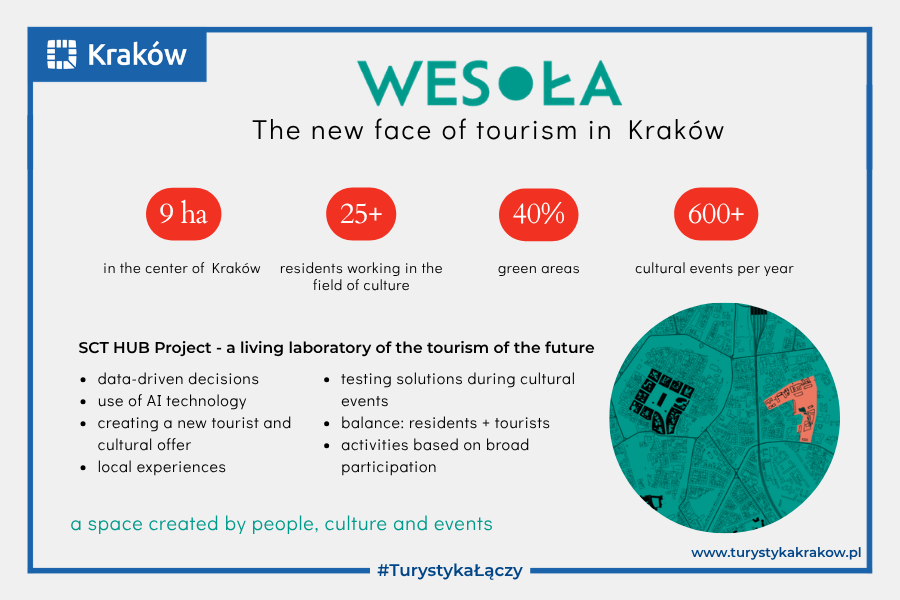
The area of the former University Hospital, purchased by the city in 2019, covers nearly 9 hectares in the very center of Kraków. Today, Wesoła is being transformed into a creative district. There are already 25 resident entities operating there—from cultural institutions to social organizations—and the number of events reaches hundreds each year. It is an area in transformation, which anyone can observe up close and actively participate in. An important part of this process includes initiatives supporting sustainable tourism.
Openness to artistic activity has become a successful strategy in Wesoła: through a variety of creative interventions, new functions and ways of using the space are being introduced. Events of different scales take place in unique and unconventional settings—from intimate workshops, through concerts in unusual venues, to large, renowned festivals. Wesoła is open to everyone, offering something for all visitors.
Wesoła as an urban project
Wesoła is developing as an open, green, and multifunctional part of the city. Around 40% of its area consists of green spaces, already accessible to residents and visitors. The Masterplan, developed in 2024, sets the direction for future development but remains an open document—continuously updated and co-created with the users of the space.
Both in the preparation of the Masterplan and in ongoing revitalization efforts, participatory processes play a key role: residents, institutions, NGOs, and experts are actively involved in shaping the district. City authorities emphasize that Wesoła is primarily a process rather than a finished investment. It is a space that “happens” thanks to people—their ideas, collaboration, and everyday activity.
EU projects driving change in Wesoła
A significant catalyst for Wesoła’s transformation is a set of EU co-financed projects that translate the Masterplan vision into concrete actions. These include FabLab Małopolska, the Culture Quarter, and the SCT HUB project.
FabLab, with nearly PLN 5 million in funding, will create a space for prototyping, creative work, and developing future skills—combining knowledge, openness to change, and the ability to collaborate with technology and people.
The Culture Quarter, supported by a PLN 50 million grant, will enable the revitalization of historic buildings and the creation of modern infrastructure for literary communities. It will connect two centers—the House of Literature and Language (an initiative of the Krakow Festival Office at ul. Kopernika 15) and the new headquarters of the Małopolska Institute of Culture in Kraków.
These efforts are complemented by the SCT HUB project, which introduces an innovative approach to tourism and cultural management. Together, these projects are the driving force behind change—gradually transforming Wesoła into a dynamic creative district.
Why Wesoła matters for Kraków’s tourism
Wesoła also represents a new direction in how tourism is approached in Kraków. The city is increasingly moving away from a simple model focused on growing visitor numbers. Instead, it prioritizes the quality of experience, a balance between residents’ and tourists’ needs, and more responsible spatial management. In this context, Wesoła becomes more than a revitalization project—it is a testing ground for a new model of urban tourism based on sharing the city and its resources.
The development of Wesoła creates new opportunities for tourism. It helps distribute tourist traffic more evenly and relieves pressure on the most crowded areas, such as the Main Market Square and Kazimierz, while respecting residents’ needs and protecting the urban fabric. At the same time, it builds an offer closer to local communities—based on contemporary culture, education, creativity, and diverse experiences embedded in Kraków’s historic identity.
SCT HUB as a laboratory of change
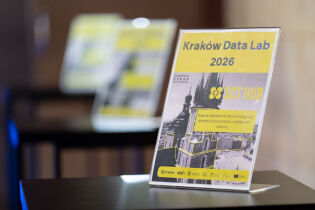
A central element of this transformation is the Sustainable Cultural Tourism Center, established through the innovative SCT HUB project. The center (or hub) is both a working methodology and a physical space, located in a former monastery in Wesoła as part of an EU-funded project running until 2028. It brings together the city, cultural institutions, universities, and social organizations. Such a broad partnership creates strong potential for building an effective system for managing knowledge about tourism.
SCT HUB operates through research, data collection, and broad participation. It integrates the voices of residents, the tourism sector, and creative communities. It also uses analytical tools, including artificial intelligence, to design and test new solutions. A key methodology is the Living Lab model—ideas are tested in real urban settings during events and cultural activities. At the same time, the tourism and cultural offer will evolve towards more demanding visitors, focusing on uniqueness rather than mass experiences.
The project addresses challenges faced by Kraków and many other European cities: excessive tourist concentration, overcrowding in city centers, social tensions, and declining quality of experience. Addressing these issues requires data-driven management and broad cooperation. The expected outcomes include concrete tools—from new event organization models to tourism development scenarios. Importantly, these solutions may also be applied in other cities facing similar challenges.
SCT HUB symbolizes a deeper shift: tourism is no longer a separate sector but becomes part of integrated urban management. It connects cultural, spatial, and social policies, relies on shared responsibility among stakeholders, and uses diverse data as a basis for decision-making. In this sense, Wesoła is not just a new district of Kraków—it is a testing ground for the future of the city and for a new model of tourism quality.
This article is part of a publication series by the Municipality of Kraków on the state of tourism in the city. The series aims to systematize key concepts and phenomena and to analyze the advantages and challenges of Kraków’s tourism based on data. It also encourages active participation in public dialogue between residents, entrepreneurs, and local government.